Smarter Decisions: Critical Thinking eBook (Digital)
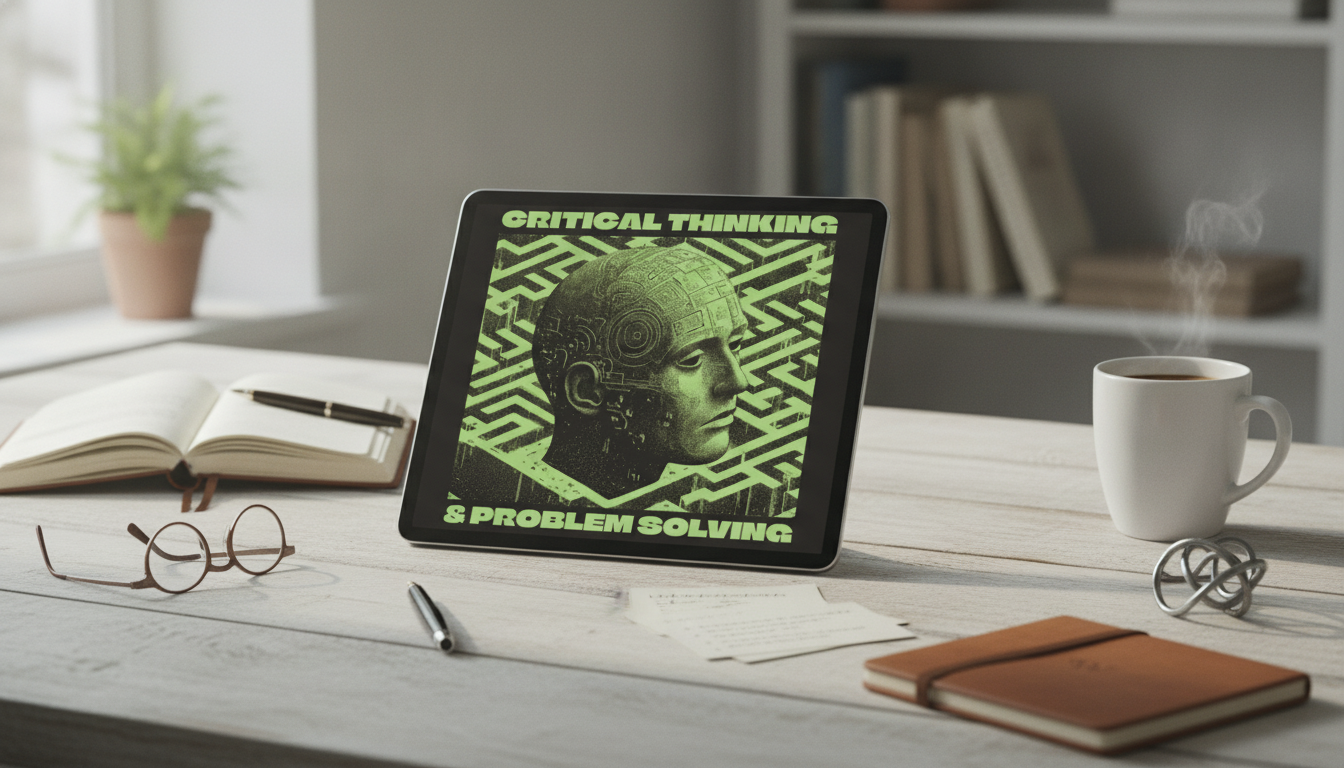
Critical Thinking & Problem Solving: A Practical Digital Guide to Smarter Decisions
Better decisions rarely come from having more information—they come from asking better questions, spotting weak assumptions, and testing options before committing. This digital guide focuses on everyday thinking skills you can practice immediately, using short frameworks, brain teasers, and realistic scenarios that strengthen judgment at work, at home, and under pressure.
To ground the skill in real definitions (not buzzwords), it helps to compare a few established references on critical thinking from the APA Dictionary of Psychology and the Stanford Encyclopedia of Philosophy.
What “smarter decision making” looks like in real life
Smarter decision making is less about “having a perfect answer” and more about consistently using a process that reduces avoidable mistakes. In day-to-day life, it often looks like this:
- Separating facts, interpretations, and opinions before reacting.
- Noticing hidden assumptions (about people, timelines, costs, or outcomes).
- Defining the real problem instead of treating symptoms.
- Comparing options with clear criteria (time, risk, values, budget).
- Choosing the “good enough” decision when perfection is unrealistic.
- Reviewing results afterward to improve future choices.
The quiet win: fewer “How did we end up here?” moments—especially when stakes are high or emotions run hot.
Common traps that derail clear thinking
Even careful people get pulled off track by predictable mental shortcuts. Naming these traps makes them easier to catch in the moment:
- Confirmation bias: searching for support rather than truth.
- Availability bias: overweighting what’s recent, vivid, or emotionally charged.
- Sunk cost fallacy: continuing because of what was already spent.
- Framing effects: changing choices based on wording instead of substance.
- Overconfidence: confusing familiarity with accuracy.
- Decision fatigue: poorer choices after too many small decisions.
A practical way to use this list is to ask: “Which trap would I be most embarrassed to realize I fell for tomorrow?” That question alone can slow impulsive choices.
A simple problem-solving loop to use anywhere
When a situation feels messy, a loop beats a single “big brainstorm.” Use this cycle to move from confusion to action without pretending you can predict everything:
- Clarify the situation: write the problem in one sentence and define success.
- Gather constraints: time, money, people, rules, non-negotiables.
- Generate options: aim for at least three (including a “do nothing” option).
- Evaluate trade-offs: list benefits, costs, risks, and second-order effects.
- Choose and act: decide, set a checkpoint date, and define the next step.
- Reflect: what worked, what didn’t, and what to do differently next time.
This loop is especially effective when paired with a “checkpoint date.” Instead of demanding certainty today, you commit to learning on a schedule.
Quick decision checklist (when time is short)
Rushed decisions don’t fail because people are careless—they fail because the brain skips steps under pressure. A short checklist keeps you from jumping straight from emotion to action.
- Use a short set of questions to avoid rushed errors without overthinking.
- Apply the same checklist to personal choices (spending, health, relationships) and professional decisions (projects, hiring, process changes).
- Pair the checklist with a brief pause: even 60 seconds can reduce impulsive choices.
Fast decision prompts by situation
| Situation | Ask | Helpful tool |
|---|---|---|
| High-stakes, low-time | What is the worst plausible outcome, and how can it be reduced? | Premortem + safety margin |
| Too many options | What are the top 3 criteria that matter most? | Weighted criteria list |
| Conflicting advice | Which claims are supported by evidence vs. authority or confidence? | Evidence check |
| Emotional decision | If a friend asked for advice, what would be recommended? | Outside-view reframe |
| Repeating the same issue | What is the root cause and what would prevent recurrence? | 5 Whys |
| Team disagreement | What would change someone’s mind, and what data could test it? | Testable hypothesis |
Why brain teasers help (and how to use them correctly)
Brain teasers get a bad reputation when they’re used to show off. Used the right way, they’re a low-stakes gym for reasoning.
- Brain teasers build comfort with uncertainty and multi-step reasoning.
- They train attention to patterns, constraints, and hidden rules.
- The goal isn’t “being clever,” but practicing structured thinking under ambiguity.
- Best practice: explain the reasoning process, not just the final answer.
- Rotate puzzle types (logic, probability, spatial, verbal) to avoid one-skill overreliance.
A simple rule for better results: after solving, write one sentence about what made it tricky (a hidden assumption, a misleading frame, or an unspoken constraint).
Life skills that grow from critical thinking practice
As the habit strengthens, it tends to spill into everything else—especially communication and self-management:
- Communication: asking clarifying questions and summarizing accurately.
- Conflict navigation: identifying interests vs. positions in disagreements.
- Financial decisions: comparing total cost, opportunity cost, and risk exposure.
- Media literacy: distinguishing claims, evidence, and persuasion tactics.
- Planning: breaking complex goals into testable next actions.
- Self-management: recognizing triggers that impair judgment (stress, fatigue, urgency).
Digital download guide: what to expect and how to get the most from it
Featured digital downloads
-
Critical Thinking & Problem Solving eBook – Digital Download Guide for Smarter Decision Making, Brain Teasers & Life Skills Ebook
Price: $27.99 (USD) Format: Digital download Status: In stock -
Solo Traveler’s Guide to Staying Safe | Guide | Digital Download PDF eBook | Solo Travel Safety Tips & Checklist | Travel Security Planning
Why it pairs well: a real-world way to apply risk thinking, checklists, and “worst plausible outcome” planning. Price: $8.99 (USD) -
The Income Multiplier Bundle | 4-in-1 Bundle | Multiple Income Streams, Dividend Stocks, Side Hustles & Strategy
Why it pairs well: practice evaluating trade-offs, opportunity cost, and second-order effects with financial scenarios. Price: $111.99 (USD)
FAQ
What are critical thinking problems?
Critical thinking problems are situations where you must evaluate information, identify assumptions, and reason carefully to reach a sound conclusion—often with incomplete data. Examples include choosing between competing options, spotting flaws in an argument, or digging past symptoms to find a root cause.











Leave a comment