Memory Boost Worksheets: Printable & Digital Study Drills
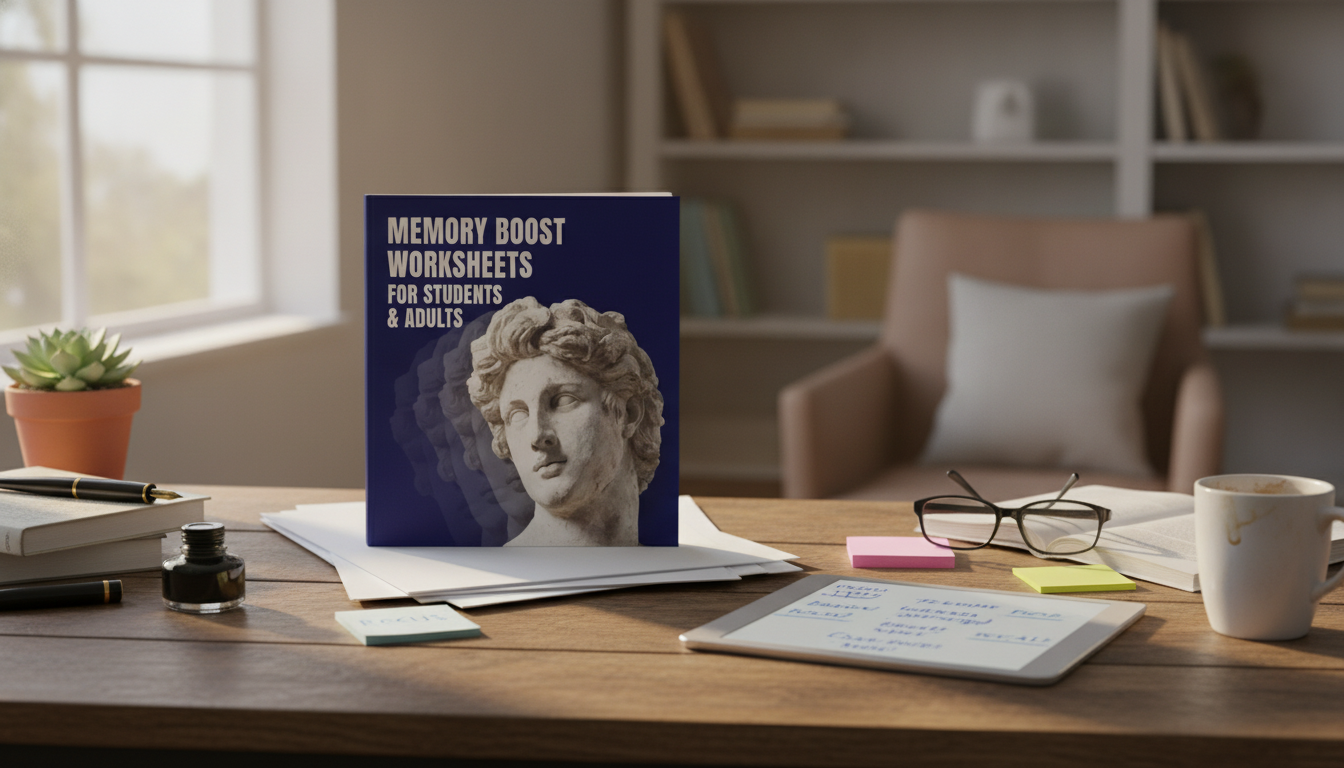
Memory Boost Worksheets for Students and Adults: Printable Exercises, Digital Tools, and Practical Techniques
Stronger memory is built through small, repeatable habits: focused attention, structured practice, and quick review. A worksheet-based approach makes it easier to train recall, track progress, and apply proven techniques to studying, work tasks, and everyday life. This guide explains how memory practice works, what to look for in a printable or digital set, and how to use a brain-training eBook and worksheets as a simple daily routine.
What “memory practice” looks like in daily life
Memory training doesn’t have to look like hours of studying. The most practical routines focus on pulling information out of your brain on purpose, then tightening the gaps with quick correction.
- Recall over re-reading: practice pulling information from memory rather than only reviewing notes.
- Short sessions win: 5–15 minutes repeated over time tends to outperform long cramming sessions.
- Use clear cues: categories, headings, and questions help the brain store and retrieve information.
- Train both systems: build working memory (holding info briefly) and long-term memory (remembering later).
- Track results: even simple checkmarks and scores reveal patterns and help maintain consistency.
Research strongly supports retrieval practice (testing yourself) and spaced review as high-impact learning methods. For a deeper look, see evidence on retrieval practice improving learning and the APA’s overview of practice testing and distributed practice.
Who benefits most from memory worksheets
- Students: improve study recall for vocabulary, dates, formulas, and reading comprehension.
- Adults at work: remember meetings, procedures, names, and step-by-step workflows.
- Lifelong learners: retain new languages, hobbies, and technical skills with less friction.
- Busy households: reduce “mental load” by strengthening routines and quick recall.
- Anyone rebuilding study habits: worksheets add structure when motivation is inconsistent.
Common worksheet exercise types and what they train
Different worksheet formats develop different “memory muscles.” A good bundle mixes short drills with trackers so practice stays simple and repeatable.
- Active recall prompts: answer questions without looking, then check and correct.
- Spaced review trackers: schedule quick revisits to prevent forgetting.
- Chunking practice: group details into meaningful units (lists, categories, frameworks).
- Visualization and association drills: link a concept to an image, place, or story.
- Name-and-face or term-and-definition pairing: strengthen cue-to-answer speed.
- Study-to-recall templates: convert notes into questions, summaries, and flash prompts.
Worksheet Activity Guide
| Activity | Best for | Typical time | How to measure progress |
|---|---|---|---|
| Active recall quiz sheet | Exam prep, training modules | 10–15 min | Accuracy % and fewer hints needed |
| Spaced review calendar | Long-term retention | 2–5 min/day | Streak consistency and recall after 7–30 days |
| Chunking map | Complex topics, procedures | 10 min | Can explain steps without notes |
| Association/visual links | Vocabulary, names, key facts | 5–10 min | Faster retrieval and fewer blanks |
| Study summary-to-questions | Turning notes into practice tests | 15 min | More questions answered correctly on first attempt |
Printable vs. digital downloads: choosing the right format
- Printable worksheets: ideal for distraction-free practice and quick annotations.
- Digital worksheets: easy to duplicate, store, and reuse across topics and semesters.
- Hybrid approach: print core trackers, keep master files digital for repeat use.
- Consider access: choose formats that work on phone/tablet/laptop plus a home printer.
- Consistency matters more than format: pick the option you’ll actually use daily.
For overall brain health habits (sleep, activity, stress, and more) that support learning alongside worksheets, the NIH’s National Institute on Aging provides a helpful overview: Brain health and cognitive function.
A simple 10-minute memory routine (students and adults)
This routine is designed to be easy enough to repeat even on busy days, while still pushing real recall.
- Minute 1: pick one topic (a chapter, meeting notes, or a short list).
- Minutes 2–6: complete a recall sheet without looking at the source.
- Minutes 7–8: check answers, mark misses, and rewrite the correct version once.
- Minute 9: create 3–5 spaced review prompts for tomorrow and next week.
- Minute 10: quick reflection—what cue helped most (image, category, story, acronym)?
Memory techniques that pair well with worksheets
- Spaced repetition: schedule reviews at increasing intervals.
- Interleaving: mix related topics instead of practicing only one type.
- Elaboration: explain “why” and “how” to make information stick.
- Dual coding: combine words with simple sketches or diagrams.
- Method of loci (memory palace): place items in a familiar location sequence.
- Mnemonic devices: acronyms, acrostics, and keyword links for fast retrieval.
Using a brain-training worksheet set as a study and recall toolkit
Product options: printable and digital downloads
- Memory Boost Worksheets for Students & Adults (Printable Digital Download)
- Solo Traveler’s Guide to Staying Safe (Digital Download PDF eBook) (great for practicing procedure recall with checklists and scenario prompts)
- Top 10 Must-See U.S. National Parks + Fast Facts (Digital Travel Guide eBook) (use fast-facts pages to create quick recall quizzes and spaced-review prompts)
FAQ
How often should memory worksheets be used to notice improvement?
Try 5–15 minutes most days, with spaced review prompts revisited over the next week or two. Many people notice steadier recall within a few weeks when they track accuracy and time-to-recall and keep sessions consistent.
Are memory worksheets helpful for adults who are not studying for exams?
Yes—worksheets can improve recall for work procedures, meeting takeaways, names, errands, and new skills. Converting real tasks into short recall prompts and checklists makes the practice immediately useful.
Do printable exercises work better than digital practice?
Either format can work: print tends to reduce distractions, while digital files are easier to duplicate and organize. A hybrid setup (print your trackers, keep master files digital) often makes daily practice simpler.











Leave a comment